Mobility · Daily Routine
A Morning Mobility Sequence for Outdoor Practitioners
Tobias Marsden··8 min read
The push-up is one of the oldest documented forms of physical conditioning still in regular use. It requires no equipment, no dedicated space, and no particular setting. And yet the number of people who can perform a structurally sound push-up — at any load — remains, by any observation, surprisingly small. This is not an argument for difficulty. It is an argument for sequence.
Before any discussion of progressions, it is worth spending time on what a structurally sound push-up actually looks like. The movement asks for a rigid plank position from the crown of the head to the heels, a hand placement roughly beneath the shoulders or slightly wider, and a descent that brings the chest to within an inch or two of the surface without allowing the hips to sag or elevate. The elbows track at roughly 45 degrees from the torso — not flared wide, not crushed against the sides.
Most practitioners who struggle with push-up progressions have not failed to develop adequate pressing strength. They have developed adequate pressing strength in a structurally poor position, which then becomes a ceiling. The hip sag that appears on rep six is not a fatigue event — it is the body revealing the compensatory pattern that was present from rep one. Working through progressions without addressing that pattern simply reinforces it at higher loads.
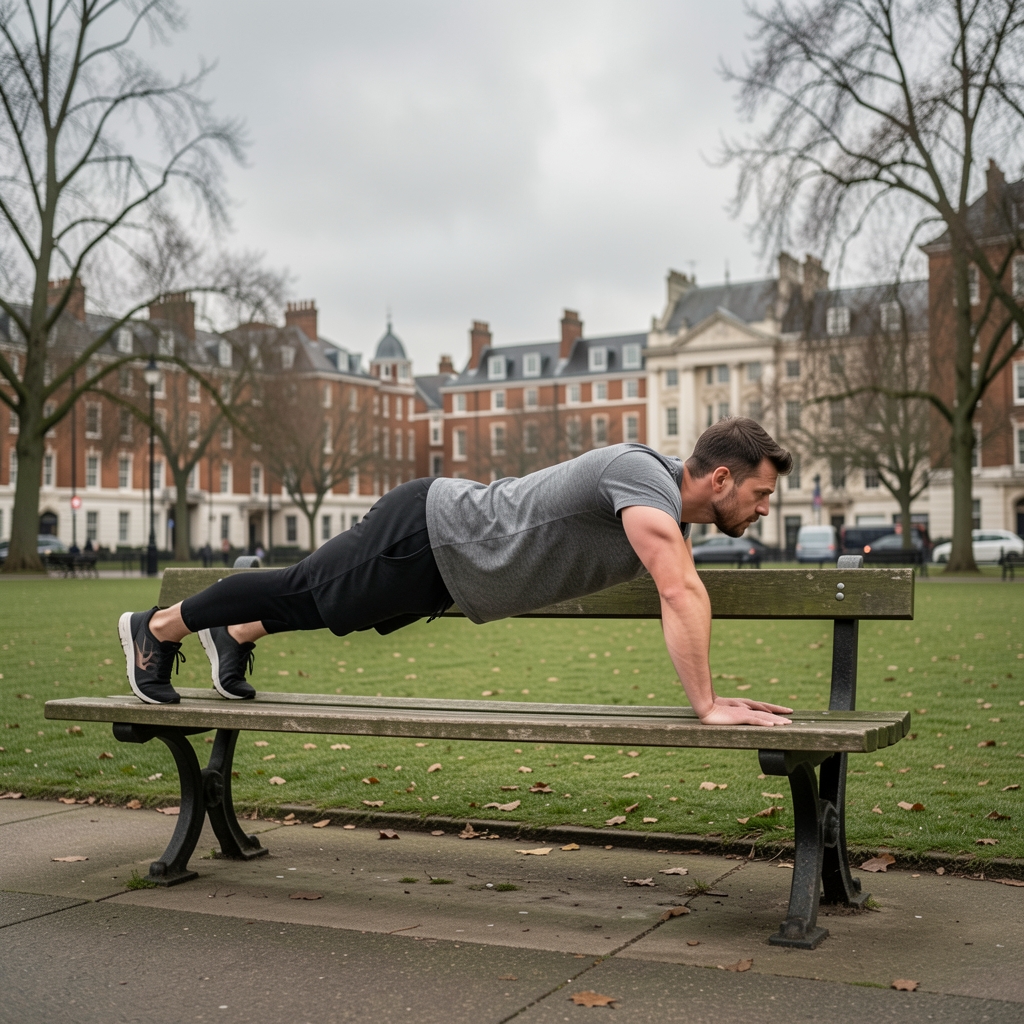
The elevated push-up — hands on a wall, a fence, a park bench — is not a simpler version of the floor push-up. It is a teaching position that allows the practitioner to find and hold a proper plank under reduced load. It belongs in the sequence of any practitioner who cannot yet maintain a plank position on the floor for forty-five continuous seconds. That is the prerequisite, and it is not a low bar.
What follows is a documented catalogue of six stages. The intention is not to directs a timeline — progressions take different lengths of time for different practitioners, and any timeline is an approximation of averages that will not match any individual with precision. The intention is to establish the sequence clearly so that practitioners understand which stage they are at and what the structural requirements of the next stage actually are.
Wall or high surface, body at 45 degrees or less. The focus is entirely on plank quality and scapular control, not on the number of repetitions completed. Three sets of ten, with a five-second pause at the bottom, is a reasonable benchmark before progressing.
Park bench or low wall, body at 20-30 degrees. Increased load relative to Stage 01. The same structural requirements apply. Proceed when three sets of twelve are achievable with no hip deviation.
The foundational position on the ground. If structural compromise appears before twelve repetitions, return to Stage 02 until the base is more secure. There is no value in completing twenty poor-quality floor push-ups if twelve sound elevated push-ups remain a challenge.
Hands narrowed to shoulder-width or slightly inside. Increased demand on the triceps and anterior shoulder. The elbows travel closer to the body than in the standard position. A useful stage for building the pressing strength required in later progressions without external load.
One arm extends to the side while the working arm performs the push-up. An asymmetric loading position that develops the unilateral strength required for Stage 06 without the full demand of a single-arm position. Requires sound shoulder stability on the extended arm.
Begin on an elevated surface to reduce load. Transition to the floor only when five structurally sound elevated single-arm repetitions are achievable. Anti-rotation demands increase significantly; this is as much a core-stability progression as a pressing one.
The stall point for the majority of practitioners is the transition from Stage 03 to Stage 04. By this point, the practitioner has developed enough relative pressing strength to perform fifteen or twenty floor push-ups. The feeling is one of competence. The error is in conflating volume with readiness. The close-grip push-up places a different structural demand on the shoulder — particularly on the glenohumeral joint — and practitioners who have built their floor push-up primarily through muscular endurance rather than structural precision often find that the close-grip position exposes a deficit that was invisible at the wider placement.
The second common stall point is between Stage 05 and Stage 06. The archer push-up is often performed too quickly — regarded as a transitional drill rather than a stage in its own right. Practitioners who rush through it arrive at the single-arm push-up with insufficient anti-rotation capacity and attempt to compensate by widening their stance, which changes the movement pattern significantly and does not develop the quality required.
"The stall is rarely a question of strength alone. It is almost always a question of sequence — which prerequisite was skipped and at what cost to the structure that followed."
Eleanor Whitfield, Olareno Letters
London's parks offer a range of surfaces, not all of them ideal for push-up practice. Grass — particularly after rain — introduces an unstable base that is better reserved for Stage 03 and above, once structural patterns are established. Tarmac paths and concrete are structurally sound but unforgiving on the wrists. A thin foam pad or folded jacket beneath the hands is not a compromise — it is a practical acknowledgement that the training surface is incidental to the purpose.
Park benches serve well for Stages 01 and 02 when the surface is dry. The texture of the wood or metal provides grip. Steps and stair edges allow for foot-elevated variations that shift load toward the upper chest and anterior shoulder — a useful variation for Stages 03 and 04 once the standard position is well established. The point is that outdoor environments provide more variation than a dedicated training space, not less, and the practitioner who uses them well has a more varied progressive toolkit than one confined to a flat gym floor.
The connective tissue of the shoulder — the tendons, the ligaments, the joint soft-gels — adapts at a slower rate than the muscular tissue. This is the physiological basis for the advice to progress conservatively. A practitioner can develop the muscular capacity for Stage 05 in eight weeks. The structural tolerance of the shoulder for Stage 05 loading may take considerably longer to establish. Training at a frequency that outpaces structural adaptation is the most common route to shoulder problems in bodyweight training — and the most easily avoided.
Three sessions per week with full rest days between pushing sessions is a reasonable starting point for practitioners at Stage 01 to Stage 03. At Stage 04 and above, two dedicated pushing sessions per week, supplemented by one session focused on scapular stability and shoulder rotation, tends to serve the progressive demands of the later stages without accumulating structural load too rapidly. These are not instructions. They are notes from observation.
Olareno Letters is an independent editorial publication. Articles are editorial in nature and reflect the writers' observations on everyday wellness practices.

Eleanor has written about outdoor fitness and functional movement for over a decade. Her particular interest is the relationship between progressive overload and practical everyday constraints.
More from Eleanor Whitfield →