Bodyweight · Push-Up Series
Notes on the Push-Up: A Practical Catalogue of Progressions for Everyday Outdoor Training
Eleanor Whitfield··9 min read
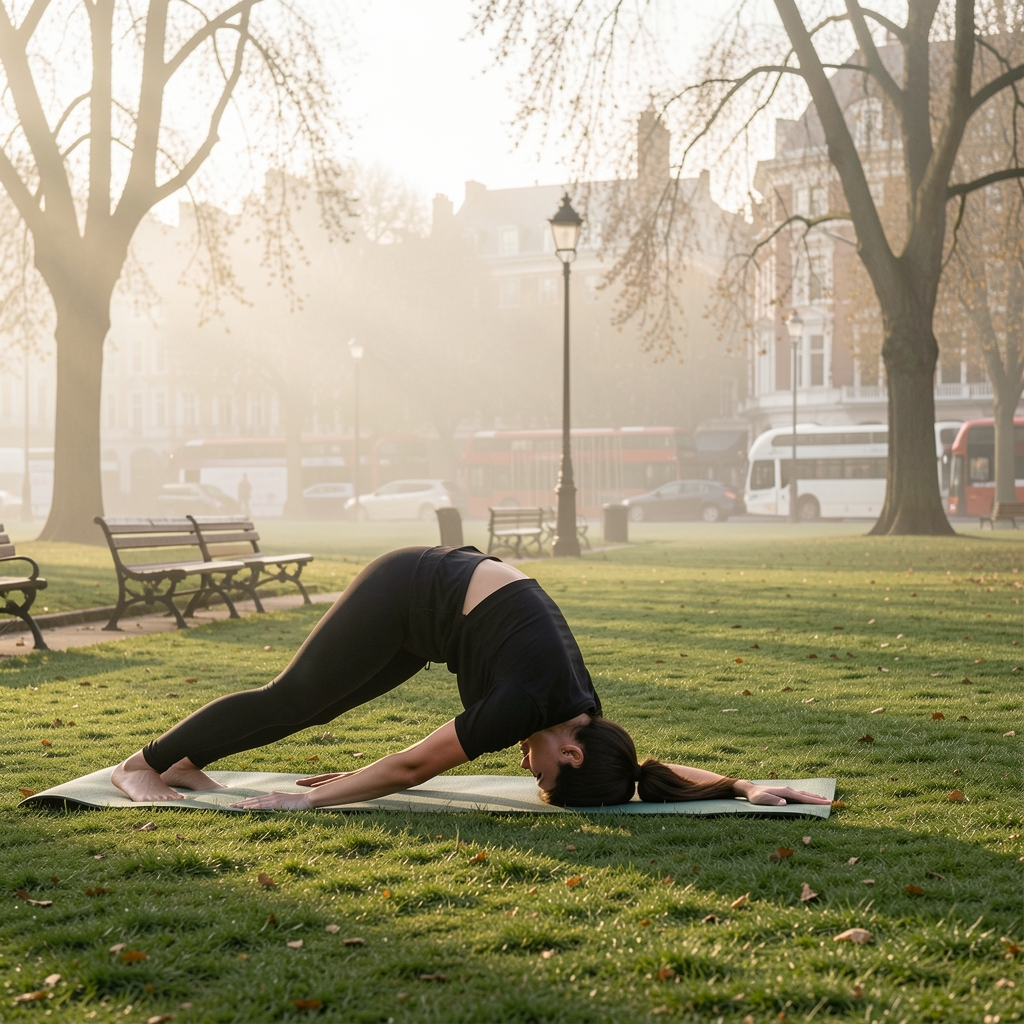
Mobility work is not preparation for training. It is a distinct practice — one with its own requirements, its own sequence logic, and its own adaptation curve. The conflation of mobility with warm-up is a source of consistent underinvestment. This sequence is designed to be performed on its own, on any morning, in any park in London, before any other physical activity begins.
Flexibility refers to the passive range of motion a joint can achieve. Mobility refers to the active, controlled range — the range within which the practitioner can generate force and maintain stability. A practitioner who can touch their toes when passively assisted but cannot achieve the same range under their own muscular control has flexibility but limited mobility. The distinction matters because passive range that cannot be actively expressed provides no protective function during physical activity and offers no functional carryover.
The sequence that follows works primarily on active range. Where passive stretching appears — and it does, briefly — it is in service of exposing range that the practitioner can then work to express actively. There are no sustained passive holds of more than thirty seconds. Prolonged passive holds have their place in a recovery context; in a morning mobility sequence, they are more likely to reduce nervous system excitation than to develop usable range.
The sequence takes approximately fifteen minutes at a measured pace. It requires a flat surface — grass or a smooth path — and enough space to extend the arms fully in all directions. A jacket or foam pad for the ground positions is advisable on hard surfaces, though not essential on dry grass.
Perform these in the order listed. The sequence moves from the ankle upward and ends at the thoracic spine. This proximal-to-distal logic — or more accurately, distal-to-proximal-in-terms-of-the-kinetic-chain — mirrors the structural loading order of most outdoor movement patterns.
Standing on one leg, slow controlled circles in both directions — ten each. Follow with a supported dorsiflexion stretch: hands on a wall or tree, front foot flat, rear knee driving forward over the toes. Thirty seconds each side. The ankle is the first joint to restrict movement in any running or squatting pattern; it deserves proportionate attention.
A controlled descent into a deep squat position, heels on the ground if possible. From that base position, reach one arm toward the sky while the other hand remains in contact with the ground or a foot. Rotate through the thoracic spine, not the lower back. Ten rotations each side. This single movement covers ankle dorsiflexion, hip flexion, and thoracic rotation simultaneously.
Seated on the ground, both legs at ninety-degree angles — one in front, one behind. Rotate slowly from one side to the other, lifting both knees and setting them down in the opposite orientation. Eight transitions. The 90/90 position exposes both internal and external hip rotation simultaneously; the transition between them develops active rotational range.
From a lunge position, the rear knee off the ground, bring the inside hand to the ground level with the front foot. Rotate the opposite arm toward the sky, following it with the gaze. Return and repeat. Five on each side. Despite its name — which belongs to a previous era of fitness marketing — this movement genuinely covers hip flexor length, thoracic rotation, and hip external rotation in a single compound position.
On all fours, standard cat-cow for five cycles to establish spinal articulation. Then add lateral flexion: allow the hip to drift toward the ribs on each side, five on each side. The combination develops segmental awareness of the spine and addresses the lateral plane that most morning movement patterns neglect entirely.
A park bench serves well here. Sit on the ground in front of the bench, place the mid-back against the edge of the bench, and allow the upper back to extend over it. Arms folded across the chest or overhead. Hold briefly and move the contact point up and down the thoracic spine. One minute total. Addresses the habitual flexion of the upper back that sitting imposes.
Slow controlled shoulder circles, both directions, ten each arm. Follow with a cross-body reach: draw one arm across the body and use the opposite arm to gently increase the stretch through the posterior shoulder. Thirty seconds each side. Brief and functional — the goal is to introduce range, not to force it.
Slow cervical rotation, ear toward shoulder on each side, five each. Lateral tilts with gentle hand pressure, thirty seconds each side. The cervical spine is often omitted from morning sequences. Its inclusion is particularly relevant for practitioners who spend extended periods at a desk — the pattern established by long hours of forward head position does not self-correct without deliberate attention.
London's parks are available year-round, and a morning mobility sequence conducted outdoors in November is not meaningfully different from the same sequence in May — with the appropriate adjustment for clothing and surface condition. Cold ambient temperature slows the initial rate of tissue warming, which means the first two movements warrant slightly more time and reduced range of exploration at the outset. This is not a reason to move the sequence indoors; it is a reason to proceed through the early stages with a fraction more patience.
Wet grass changes the calculus of floor-based movements. The 90/90 transition and cat-cow elements are more comfortable on a dry surface. A folded jacket, a small mat, or a dry path provides adequate surface for these positions without requiring a gym floor. The outdoor practitioner develops a practical relationship with available surfaces — part of what makes outdoor fitness a distinct discipline from facility-based training.
"Mobility work is not preparation for training. It is a distinct practice with its own sequence logic and its own adaptation curve — one that returns investment over months, not sessions."
Tobias Marsden, Olareno Letters
This sequence is designed for daily use. The movements are not exhausting; they are restorative in the sense that they address the positional compromises accumulated by ordinary daily patterns of sitting, carrying, and commuting. Daily practice returns a compounding benefit over three to six months that a twice-weekly practice does not. This is a function of neurological adaptation — the nervous system learns to permit and control greater range through consistent low-intensity exposure rather than infrequent high-intensity stretching sessions.
Practitioners who find fifteen minutes unavailable on a given morning can reduce to the first four movements — approximately eight minutes — without losing the primary structural benefit. The sequence is modular in this sense: the first four movements cover the hip and lower limb patterns that are most directly relevant to running and bodyweight training. Movements five through eight address the thoracic and cervical patterns that require attention on their own schedule.
Olareno Letters is an independent editorial publication. Articles reflect the writers' observations on everyday wellness practices.

Tobias writes on mobility, flexibility, and the active recovery practices that support sustained outdoor training. He brings a background in movement education to subjects often reduced to warm-up routines and foam-rolling guides.
More from Olareno Letters →